Government
Euclid City Council Gives Itself Power to Remove, Ban Speakers at Public Meetings
The new rules let the council president alone decide who is out of order, with no defined standard for decorum and no appeal process for banned residents.
By Staff · August 28, 2026
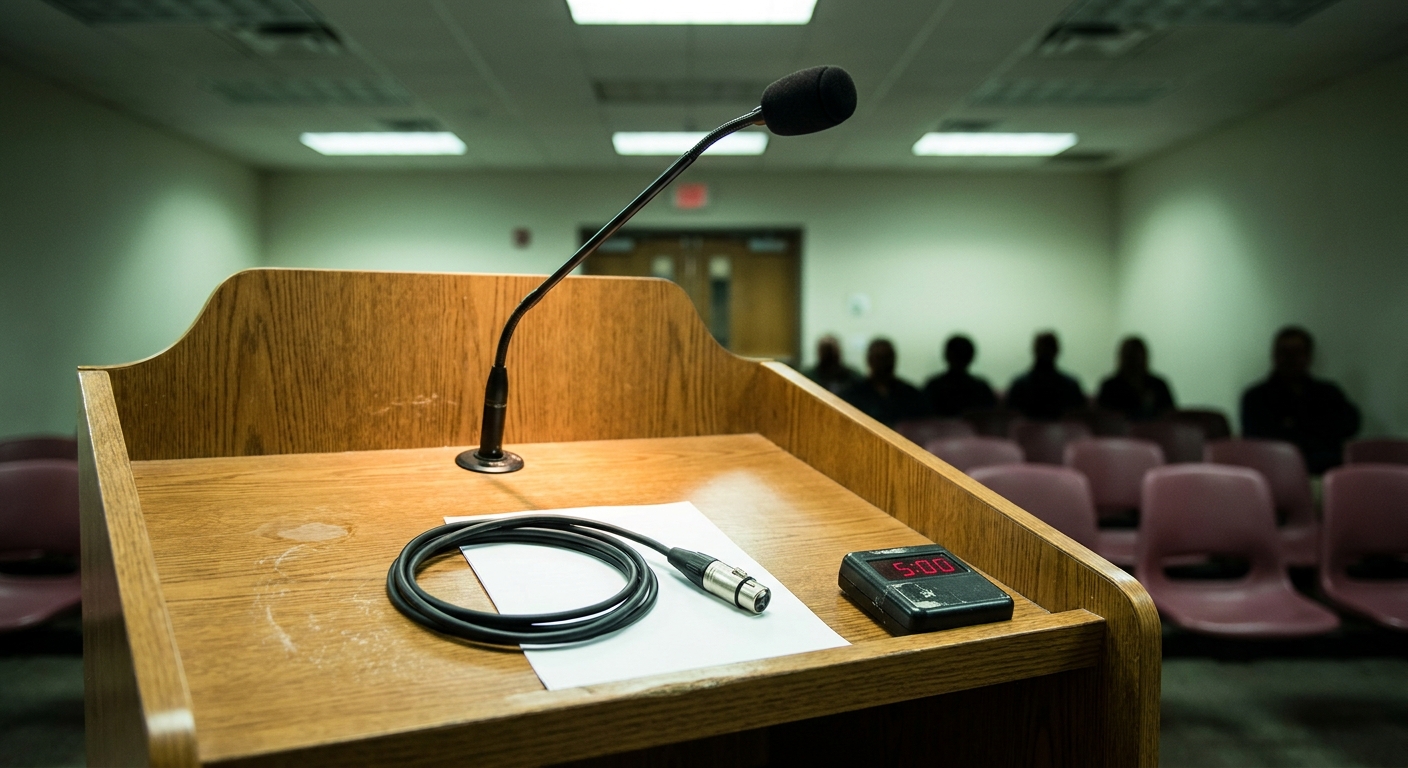
Euclid City Council on Aug. 18 adopted new Rules of Procedure that allow officials to remove residents deemed disruptive from council chambers and temporarily bar them from speaking at future meetings — a formal expansion of the body's authority over who gets heard at the podium.
The ordinance grants Council President Kristian D. Jarosz sole discretion to declare a speaker out of order and trigger escalating sanctions, up to and including a two-meeting suspension, with no council vote or external review required before penalties take effect.
Jarosz framed the changes as procedural housekeeping. "Per our charter it is council that makes up the rules on how we run council meetings so we worked with the law department to clean a few things up…" he said.
How the rules work
The enforcement ladder is straightforward. When the council president calls a speaker out of order, the speaker must stop talking immediately and wait for permission to continue. A second out-of-order call during the same session ends the speaker's time at the podium. If the speaker does not leave voluntarily, they can be physically removed from chambers and suspended from speaking at Committee of the Whole for the next two council meetings.
A separate provision extends that reach across sessions: two out-of-order calls within any three-month window during Committee of the Whole can also trigger a two-meeting ban.
The threshold for being ruled out of order is "failing to maintain decorum" — a standard the ordinance does not define. It does not specify what language, tone, or content crosses the line, leaving residents uncertain whether pointed criticism or allegations of impropriety could trigger removal.
The rules also prohibit speakers from directing comments to individual council members, meaning a resident cannot name a specific elected official at the podium when challenging a vote, a spending decision, or a public statement.
The ordinance includes no appeal process, review mechanism, or avenue for a resident who believes they were improperly removed or suspended to challenge the council president's ruling.
What prompted this — and what didn't
The rules were discussed at the July 20 council meeting before their Aug. 18 adoption. But available records from that discussion and from prior council sessions show no documented incident of a speaker being removed, a meeting being disrupted, or council citing a specific confrontation that necessitated expanded removal powers.
The most notable recent public comment on record came during a Dec. 1, 2025, Committee of the Whole meeting, when resident Christopher Michael Latwinowicz used his five minutes to allege election intimidation, say he might pursue an election contest, and urge salary caps for local officials and employees. No removal or disruption was documented at that session.
The rule change arrives, however, during a period of significant fiscal and spending pressure. City leaders estimated a $2.7 million operating shortfall for 2026 at a Feb. 23 budget hearing, attributing roughly $1.6 million of the gap to an extra biweekly pay period that inflated personnel costs. In August, council passed an emergency ordinance increasing costs on the East 220th and East 221st North of Lakeshore Boulevard sewer and waterline replacement project by more than $1.5 million, pushing total spending to $6,915,983. Officials cited unexpected conflicts with existing utilities and previously undocumented underground structures.
Those are precisely the kinds of decisions — budget shortfalls, cost overruns, emergency spending — that draw residents to the podium.
A shrinking window
The new rules land on top of a public comment period already cut in half. On Aug. 19, 2024, council reduced speaking time from two five-minute periods — totaling 10 minutes — to a single five-minute block.
Ohio's Sunshine Law requires municipal council meetings to be open to the public but does not require a public comment period at those meetings. That means the comment period Euclid provides, and the rules governing it, are entirely at council's discretion.
Legal precedent next door
Euclid is not the first Northeast Ohio city to face scrutiny over public comment restrictions. Cleveland City Council settled a First Amendment lawsuit over its own rules in February 2024, agreeing to revise several provisions — including limits on directly addressing council members and on indecent and discriminatory language — and paying the plaintiff $500 plus legal fees. Cleveland's current rules do allow the presiding officer to immediately remove someone who "substantially interrupts" proceedings, with law enforcement assistance available after a verbal warning.
What residents can still do
The full council that voted on the new rules consists of Jarosz and eight ward representatives: Ward 1's Wallace Tanner, Ward 2's Richard Tolton, Ward 3's Dontea Gresham, Ward 4's Greg Cosgriff, Ward 5's Tara Hannum, Ward 6's John M. Wojtila, Ward 7's Maryann Dybiec, and Ward 8's Angela Steele.
Residents suspended from speaking can still attend meetings as observers, submit written comments or public records requests, and contact individual council members outside the chamber. The full text of the new Rules of Procedure has been posted in the City Hall lobby and is available on request, with a later posting on the council webpage possible.
Euclid's city charter also preserves formal initiative and referendum powers. An initiative petition requires signatures from not less than 10 percent of electors who voted for governor in the most recent gubernatorial election in the city; once certified, the measure goes before voters at the next general election occurring at least 90 days after certification.
Residents who believe the rules violate their First Amendment rights could consult a civil rights attorney or an organization that litigates free speech cases — following the path that produced Cleveland's settlement and revised rules.
The core question the ordinance leaves unanswered: what, exactly, constitutes the "decorum" a speaker must maintain to keep their place at the podium — and who, besides the official whose decisions may be under challenge, gets to decide?