Local News
Euclid Reviews Sole Proposal for 50 Homes at Former St. Robert Church Site
The city received only one bid for the lakefront site, and design reviewers are pushing for more streetscape variety before approving the roughly 50-home plan.
By Staff · August 20, 2026
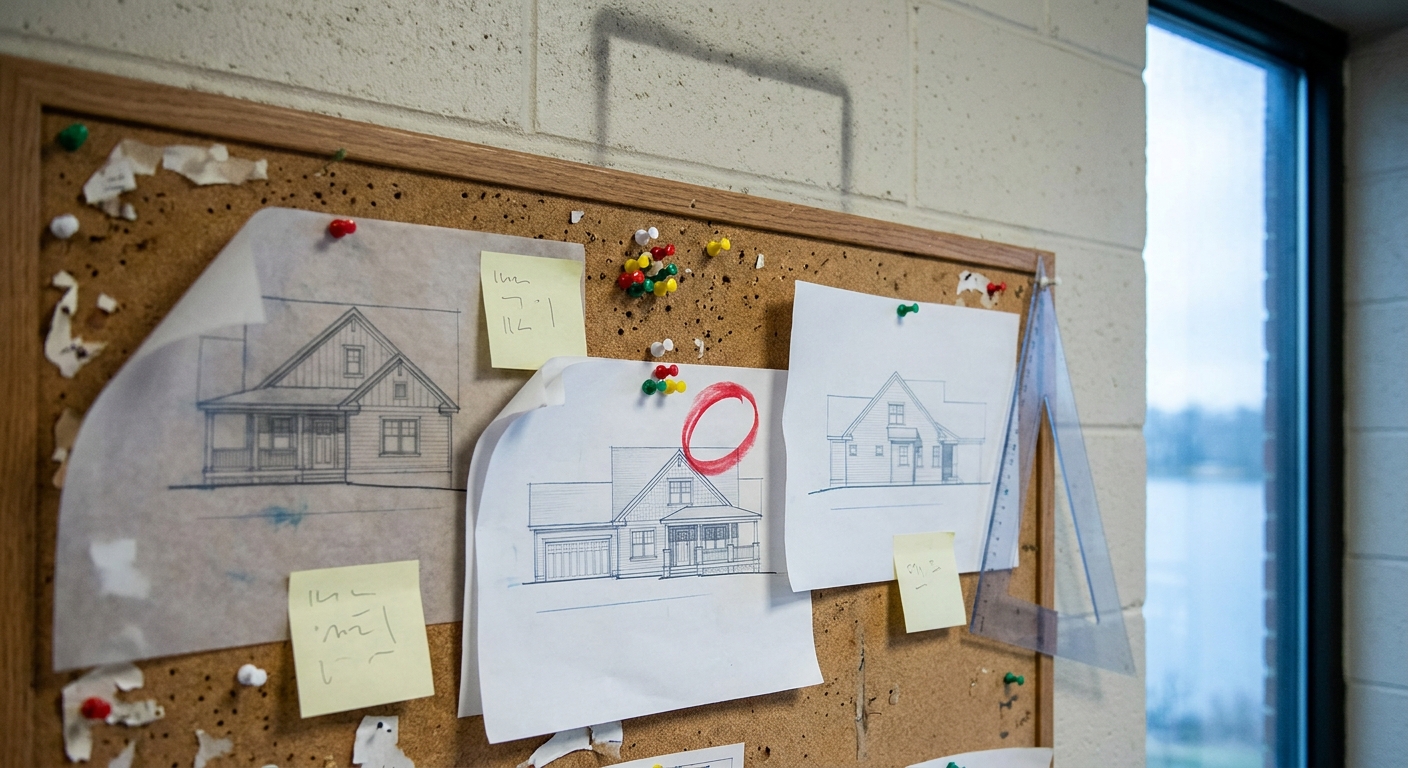
A proposal to build roughly 50 single-family homes at the former St. Robert Church site is moving through Euclid's review process, giving residents their first detailed look at what could replace a longtime neighborhood anchor at 23802 Lake Shore Boulevard.
The development team submitted the sole response to the city's request for redevelopment bids, which closed Feb. 6, 2026. Euclid City Council then voted at its March 2, 2026, meeting to transfer the church site and related parcels to the Community Improvement Corporation of Euclid so they can eventually be sold for redevelopment.
The ECIC hosted a St. Robert Site Open House on June 16, 2026, where residents could meet the development team and learn about its plans. The project remains under active design review as of mid-2026: Architectural Review Board members have requested more variation in the streetscape and additional renderings before the proposal returns.
The review will test whether the development will provide housing that existing residents can afford or primarily serve market-rate interests. The ECIC, which is handling the process, serves as the city's agent for promoting industrial, economic, commercial and civic development under Ohio Revised Code Section 1724.
From Parish Campus to Lakefront Housing Site
The roughly 8-acre property sits on Lake Erie next to the Euclid Lakefront Trail. The site has been cleared, leaving only the former parking lot.
St. Robert's history as a neighborhood institution stretches beyond the now-vacant property. The former St. Robert Bellarmine Parish and St. William Parish merged on Jan. 3, 2010, forming Ss. Robert & William Catholic Parish at the former St. William campus at 367 E. 260th St., Euclid.
The city's request for proposals calls for the property to become a predominantly owner-occupied residential development, emphasizing detached and attached single-family homes, including townhomes. It asks for a dynamic mixed housing program that engages the community and connects the site with the surrounding neighborhood. The design should respectfully incorporate elements of the former St. Robert Church and complement neighboring homes.
The property is zoned Attached Single Family, or ASF, though the city identified possible flexibility through a Planned Unit Development, or PUD, that could allow a more adaptable layout.
What the Sole Proposal Includes
The development team's conceptual plan calls for roughly 50 single-family homes, an internal street with a 10-foot bike path, underground utilities and a retention basin.
Three house types — Iris, Lily and Marigold — are under consideration. The homes would range from about 1,660 to 2,150 square feet, with about 10 feet between houses and front setbacks of approximately 20 feet along the new road.
The city said submissions would be evaluated based on the development team's experience, project vision, financial feasibility, community engagement and diversity participation. The RFP also said the project could potentially receive support through incentives such as PACE, TIF, NCA and HOME funds, while first-time homebuyers may have access to EDCOR down-payment assistance.
Who Will Make the Decisions
The ECIC Board of Trustees includes Kirsten Holzheimer Gail as president; Kris Jarosz as vice president; James Smith as secretary-treasurer; Greg Cosgriff, Tara Hannum, Patrick Grogan-Myers, Howard Drake, Traci Hissam, Daniel Burns and Tina Dick; and one vacant position.
Gail is both Euclid's mayor and president of the ECIC. City Council members Cosgriff, who represents Ward 4, and Hannum, who represents Ward 5, also serve as trustees on the board that issued the St. Robert RFP and will negotiate the site's sale to the selected developer.
City officials emphasized during the March 2 Council meeting that transferring the parcels to the ECIC was an administrative step rather than approval of a particular development plan, and that proposals and community engagement would proceed through the city's standard planning review.
A PUD rezoning would create another formal stage for public involvement. Under Euclid's process, City Council must hold a public hearing before passing a PUD rezoning ordinance and publish notice in a newspaper of general circulation at least 30 days in advance. If the rezoning affects 10 or fewer parcels, the city clerk must also send written notice at least 20 days before the hearing to property owners within, contiguous to and directly across the street from the affected parcels.
Other recent ECIC housing funding does not impose requirements on the St. Robert proposal. The corporation received a $402,000 Welcome Home Ohio grant in May 2026 to purchase 10 homes as part of statewide housing-development efforts. The Euclid Board of Control also approved a $20,000 grant agreement with the ECIC to support its local economic and housing development work. Neither funding source is directly tied to the St. Robert redevelopment or creates enforceable accountability for the developer selected through the RFP process.
How Residents Can Participate
Residents seeking commitments on affordability, local hiring, design or other community priorities can follow the project through several public bodies.
ECIC Board of Trustees meetings are open to the public, with notices and agendas posted on the City of Euclid website. Meetings are held at Euclid City Hall, 525 E. 222nd St., Euclid. The Euclid Architectural Review Board normally meets at 7 p.m. on the fourth Thursday of each month in the Council Chambers at the Euclid Municipal Center. Residents can also monitor the city's official St. Robert redevelopment page for updates on the proposal review and approval timeline.
If Council schedules a required public hearing on a PUD rezoning, owners of property within, contiguous to and directly across the street from the site must receive written notice from the city clerk at least 20 days beforehand, providing adjacent neighbors a statutory opportunity to testify. The Architectural Review Board's request for more renderings and greater streetscape variation shows that key design details remain open to revision through public and board scrutiny.